Auction Catalogue




 Create new list
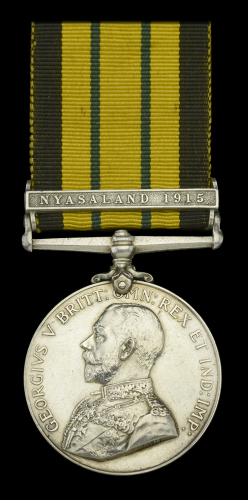
The remarkable A.G.S. ‘Nyasaland 1915’ awarded to Captain J. ‘Jimmy’ Sutherland, a storied character and infamous elephant hunter who was ‘reputed to have a more intimate knowledge of Eastern and Central Africa than any other living man’. Over the course of 40 years in Africa, Sutherland was decorated by the Germans, the French and the British. He was wounded whilst fighting as a Volunteer for the Germans during the Maji-Maji Revolt of 1905, and later wrote and published The Adventures of an Elephant Hunter in 1912.
Sutherland was employed as Chief Intelligence Officer by Brigadier General Northey in the aftermath of the Nyasaland Revolt of 1915. He received a gun shot wound to the stomach during the night raid on Spinxhaven, Lake Nyasa, 30 May 1915 - for which he was M.I.D.
Returning to the bush after the Great War, Sutherland carried on hunting and eventually succumbed to the effects of poisoning by the Azande tribe - dying in the Sudan in 1932
Africa General Service 1902-56, 1 clasp, Nyasaland 1915 (Captain J. Sutherland.) very fine £700-£900
This lot is to be sold as part of a special collection, Medals from an Africa Collection.

View
Collection
James H. Sutherland was born in Scotland in 1872, he was the son of James Sutherland, a fishcurer, of Lewis Street, Stornoway. With an inheritance of £500 in his pocket he decided to seek his fortune in Africa, and accordingly in 1896 set sail for Cape Town. On the ship he met the noted prize fighter Kid McCoy and volunteered to act as his sparring partner. He was so successful that McCoy urged him to turn professional. He declined, but later when his funds were running out he fought the ex-champion of all India. Sutherland knocked him out in the 9th round and collected the purse of £200.
Sutherland took work of any kind, which included running an African store, as a labour overseer on the Beira-Mashonaland Railway and general labouring. Whilst in Beira he got into serious trouble with the Portuguese authorities, and when a policeman tried to arrest him to settle the argument Sutherland promptly knocked him out. He spent some time in hospital in Johannesburg whilst he recovered from the effects of a bullet wound! In 1899 Sutherland decided to become a professional elephant hunter having seen the trophies bought back by others.
In 1902 the Portuguese tired to arrest Sutherland again, this time for hunting without a permit. He crossed over into German East Africa, where he remained until the outbreak of the Great War in 1914. In the interim period Sutherland became involved in the Maji-Maji Revolt of 1905, when he fought as a volunteer with the German forces against the Watai and Angoni tribes. He was seriously wounded at one point by a thrust from an Angoni assegai, and eventually decorated with what he described as “a Prussian War Decoration from the German Government”. It was the Iron Cross.
In 1912 Sutherland had The Adventures of an Elephant Hunter published. At that time, in the space of ten years, he had gained a world record of having shot 447 bull elephants (he did not count females). It is estimated that during the course of his hunting career, always alone apart from bearers and their families, that Sutherland had shot a total of 1,200 elephants. He hunted in Mozambique, Tanzania, Uganda, Congo and Malawi. Sutherland’s final hunting ground was the remote area of what is now the Central Africa Republic, and Chad.
Rebellion once again led to opportunity for Sutherland. He was appointed Chief Intelligence Officer on the staff of Brigadier General Northey, in the aftermath of the Nyasaland revolt of 1915. Sutherland, despite being ribbed as a ‘Hun soldier’ for his previous exploits, spent the majority of the Great War providing intelligence on the movements of General Lettow von Vorbeck’s forces (entitled to 1914-15 Star trio). Sutherland’s familiarity with the African terrain and his deep knowledge of the ways of the bush greatly contributed to the war effort in that theatre.
Sutherland was badly wounded whilst on a night reconnaissance at Spinxhaven, 30 May 1915. On the latter date the King’s African Rifles successfully raided the German station at Spinxhaven on the eastern shores of Lake Nyasa. The 180 men of the K.A.R. captured the local German fort, and effectively disabled the armed steamer Hermann von Wissman.
Sutherland was mentioned in the despatch of Lieutenant Colonel G. M. P. Hawthorn, 1st K.A.R., dated 11 October 1915, at Zomba (London Gazette 3 August 1916). Sutherland is listed as the only British casualty for this raid, and further details can be found in Nyasaland in the World War 1914-18 by Sir Hector Duff:
‘He [Sutherland] was as hard as a nail, and took great pride in the exceptional strength of his muscles, which he was careful to maintain by anointing himself with some kind of oil, and practising a regular system of physical exercises. As it happened, the fad probably saved his life. During a brush with the Germans, at a place called Spinxhaven on Lake Nyasa, he was shot full in the stomach, when instead of falling, he began to run about, clasping his belly with both hands, like a man suffering from colic and yelling for a doctor. It appeared afterwards that, instead of piercing poor Jimmy’s intestinal wall, the bullet had been deflected and stopped by the extra-ordinary thickness of his abdominal sinews, from which, in due course, it was extracted, the patient thus recovering, without much harm, from a wound which must otherwise have destroyed him.’
Sutherland advanced to Temporary Captain in August 1916, and the following year he was appointed Chief Intelligence Officer and awarded the French Legion of Honour, Croix de Chevalier (London Gazette 31 August 1917). Sutherland relinquished his appointment of Chief Intelligence Officer, Nyasaland- Rhodesia Field Force in June 1918 and returned to the bush. Sutherland died at the Yubo Sleeping Sickness Camp in Sudan, aged 60, in June 1932. He had been weakened by poisoning he had received at the hands of the Azande tribe in 1929, and had never fully recovered. Sutherland had continued to hunt until the end, and was buried in the Sudan, with a bronze memorial plaque marking his grave thus ‘To the memory of that Great Elephant Hunter Jim Sutherland who died at Yubo, June 26th 1932, aged 60 years. Erected by a few of his friends and fellow hunters.’
Sutherland’s .577 double barrelled rifle was sold at Bonhams for £66,000 in 2007. His life is also featured in The African Hunters by P. Capstick, and his death was reported in Tatler amongst other publications.
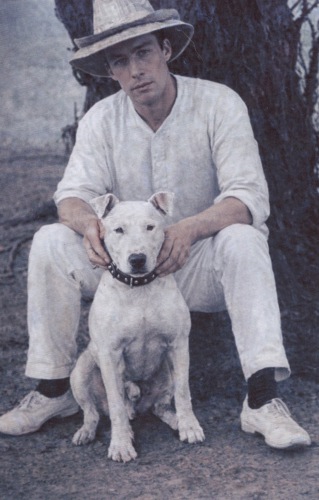
Sold with extensive copied research, including photographic images of the recipient.
Share This Page