Auction Catalogue




 Create new list
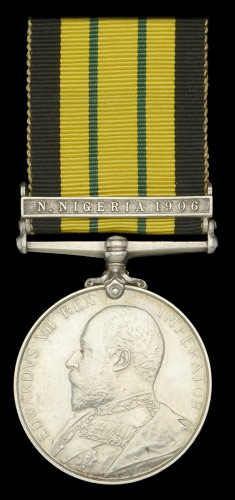
The superb A.G.S. ‘N. Nigeria 1906’ awarded to District Superintendent Captain N. Biggs, Northern Nigeria Constabulary, who was mortally wounded by a poisoned arrow whilst in the process of carrying out an arrest, February 1908. A veteran of the Second Boer War where he had served with the 4th (Glamorganshire) Company, 1st Battalion, Imperial Yeomanry and been wounded in action near Vrede, 10 October 1900.
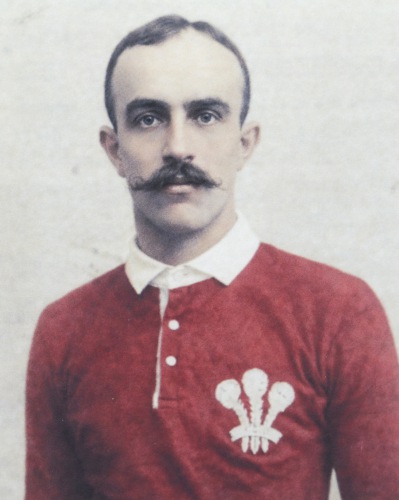
Biggs won 8 caps playing Rugby for Wales, making his debut in 1888 against the New Zealand Natives, when aged only 18 years and 49 days. He held the record as the youngest Wales international for over a century, and went on to be part of the Wales team that won the nations’ first Triple Crown in 1893. He played 166 times for Cardiff, and was a prolific try scorer from the wing - holding the club record for points scored in a season, until it was eventually bettered in the 1972-73 season. Captain of Cardiff, and one of four brothers to play for the Barbarians, Biggs prematurely finished his playing career as Captain of Bath, 1899-1900
Africa General Service 1902-56, 1 clasp, N. Nigeria 1906 (D. Supt: Captain N. Biggs N.N.C.) good very fine £800-£1,200
This lot is to be sold as part of a special collection, Medals from an Africa Collection.

View
Collection
Norman Biggs was born in Cardiff, Waels in November 1870. He was educated at Lewinsdale School, Weston-super-Mare, and University College Cardiff and Trinity Hall, Cambridge. Further details of his life were given in the Evening Express, 3 March 1908:
A Brilliant Athletic Career. Footballer, Sprinter, and Warrior
Sad news reached Cardiff this morning. It was to the effect that Captain Norman W. Biggs, the well-known Welsh international footballer [Rugby football], had been killed in Northern Nigeria. The message which his family received was that he had been wounded and died from excessive bleeding.
There never appeared on a football ground a more popular player than Norman, as he was familiarly called, and regret for his death, at the early age of 35, will be very far reaching.
Captain Biggs was in every respect a type of man who other men respect. His chief attractions were undaunted pluck in awkward positions, whether on the football ground or on the battlefield, his unostentatious manner, and his warm heartedness. He was a son of Mr John Biggs, who was the owner of the South Wales Brewery.
Robbed of his Blue
Leaving Cardiff College, he graduated at Cambridge, and took up his residence at Trinity Hall. Here one of his first accidents occurred. In playing football he had a couple of ribs broken, and the necessary rest robbed him of his Blue. He, however, made a name in sprinting, and it is on record the he did the 100 yards in even time. He had against him such flyers as Moneypenny and Charles. It was a remarkable thing that in a 100 yards Norman could beat Monneypenny, but at 120 the latter could always reach the tape first, his explanation being that Norman was the better starter.
In the Boer War
For some years Captain Norman Biggs assisted his father in business, and at the outbreak of the South African War he joined the Glamorgan Imperial Yeomanry as a trooper. He had some narrow escapes from the Boer sniping, and on one occasion when Cyril Neil was killed. Norman and Sergeant Thomas of the Glamorgan Police, were wounded [near Vrede, 10 October 1900, later commissioned Lieutenant, 106th Imperial Yeomanry, entitled to Q.S.A. with ‘Wittebergen’, ‘Cape Colony’ and ‘Transvaal’ clasps]. The former was invalided home, a Mauser bullet having entered one of his legs near the knee and emerged from the thigh. Nothing daunted, he went out again with the rank of Lieutenant, and after a spell at home joined the Colonial forces in Nigeria where he met his death.
Brilliant Footballer
Norman Biggs name will ever be associated with Cardiff football. As a runner he was absolutely fearless and many a sensational try did he score simply through his dash and determination in going for the line. In the year of his captaincy he was perhaps, in his very best form, and in 1893 he played for Wales against England, Scotland and Ireland, and in 1894 against England and Ireland.’
The above does perhaps not quite do justice to the Biggs, and his rugby career. He won 8 caps for Wales, including his debut against the New Zealand Natives at St Helen’s in 1888. Biggs was aged 18 years and 49 days making him the youngest player to have been called up for Wales, and indeed this was a record that lasted over a century until Tom Prydie was called up in 2010. Biggs played in the Home Nations Championship of 1893, when Wales won all 3 matches and won the Triple Crown for the first time. Biggs scored tries against England and Scotland in that tournament. His younger brother Selwyn also went on to be capped by Wales.
Biggs played 166 times for Cardiff, and was a prolific try scorer - holding the club record for points scored in a season until it was eventually overhauled during the 1972-73 season. He captained Cardiff, and was one of 4 brothers to play for the Barbarians. Biggs also played for Richmond, London Welsh, and captained Bath, 1899-1900.
Biggs relinquished his commission in September 1901, but then took a commission in the 3rd Battalion, Welsh Regiment in June 1903. He was appointed Instructor of Musketry in May 1905, and then seconded to the Colonial Office for service in Northern Nigeria the following year. Biggs advanced to Captain, and served as a Superintendent of Police. The next chapter of his life was chronicled in the Weekly Mail, 16 May 1908:
Captain Norman Biggs. Details of the Tragedy in Nigeria
A detailed account of the events that led to the death of Captain Norman Biggs in Northern Nigeria has been given by Doctor Gordon Hall, who attended the deceased officer. On Wednesday, February 19th Captain Biggs started of North, mounted, accompanied by three spare horse, and grooms and 24 native police on foot, leaving Kontagora early in the morning and arriving at Ribbo, a distance of twenty-four miles that night, where they encamped. The next day at Sakaba, twenty-two miles away they were joined by Captain Campbell with ten soldiers, and the combined forces went on to Chinuka, where their orders were to arrest some Pagans who had been pillaging. On approaching the village the Pagans, whilst harvesting their crops sighted them and opened fire, the troops returned fire.
Captain Biggs, who in the attack had emptied his Colt and killed three natives, did not reload but immediately rode on to the next village to allay the alarm which would, naturally, have been aroused in the minds of the inhabitants when they saw the village of Chinuku in flames, and to explain to them that his force had no quarrel with them, and that they had nothing to fear.
Unfortunately, his mission was misunderstood by the inhabitants, one of whom before Captain Biggs could get near enough to explain his errand, shot him in the thigh with a poisoned arrow.
Captain Campbell saw the arrow fired, but did not know that Biggs was wounded, and it was only after he had pursued and killed the shooter of the arrow that he found Captain Biggs, who had pulled out the arrow, trying to get off his horse. He cauterised the wound with a red hot native knife, and superintended the removal of the wounded officer to Sakaba, a distance of 50 miles. In this affair one native policeman had been hit by a poisoned arrow and one horse had been killed. At Sakaba Captain Biggs remained till the doctor arrived four days later, tended by Captain Campbell, and his own native sergeant-major, who was devoted to him. He was perfectly conscious and suffered little pain, but never really rallied, and died very suddenly the following morning, the 27th February in spite of the unremitting attention of the doctor, Captain Campbell and the sergeant-major.
It is supposed that one or two attacks of malaria had so weakened his heart that he was not able to stand the sudden loss of blood. He was buried within the fort of Sakaba with full military honours, with a firing party of 30, and his own men carried him to the grave. The arrow has been brought home for analysis.’
Sold with extensive copied research, including photographic image of recipient in Wales’ jersey.
Share This Page