Auction Catalogue




 Create new list
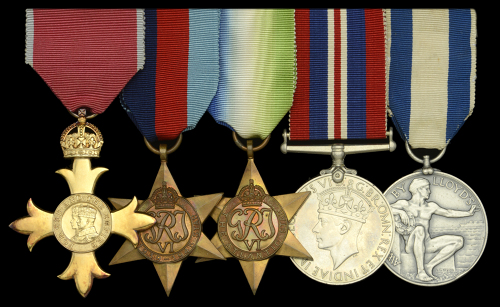
A fine Second War O.B.E., Lloyd’s War Medal for Bravery at Sea group of five awarded to Chief Engineer Officer S. G. Moffitt, Merchant Navy, who risked becoming trapped in a red hot ‘iron coffin’ when the petroleum tanker M.V. Maja was repeatedly torpedoed by a German submarine off the Isle of Man in 1945
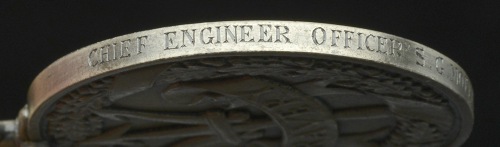
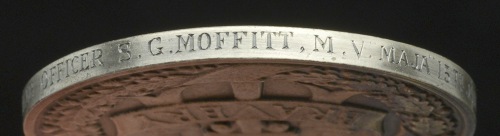
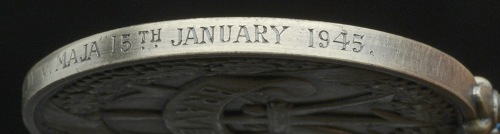
The Most Excellent Order of the British Empire, O.B.E., (Civil) Officer’s 2nd type breast badge, silver-gilt, in Royal Mint case of issue; 1939-45 Star; Atlantic Star; War Medal 1939-45; Lloyd’s War Medal for Bravery at Sea, silver (Chief Engineer Officer S. G. Moffitt, M.V. “Maja” 15th. January 1945.) with original wearing pin, extremely fine (5) £1,600-£2,000
O.B.E. London Gazette 8 May 1945.
The official citation states: ‘The tanker was sailing alone when she was torpedoed. The explosion caused a fairly heavy list and, whilst attempts were being made to trim the ship, two more torpedoes hit her. She caught fire and later sank. The loss of life was heavy, 25 of the crew being missing out of a total of 65 on board. The Chief Engineer Officer displayed outstanding bravery and disregard of his safety. When the ship was first hit, it was apparent that trimming or discharge of the cargo might be necessary and he volunteered to go into the pump room to operate the valves. The pump room was about thirty feet below decks and he was fully aware of the tremendous risks of fire, explosion, or of being trapped below. He was in the pump room when the second and third torpedoes hit the ship and was fortunate in being able to escape.’
Lloyd’s War Medal for Bravery at Sea London Gazette 26 July 1946.
Sydney Goss Moffitt was born in Tynemouth, Northumberland, on 17 August 1903, the son of grocer’s assistant John Moffitt of 110 Middle Street, Newcastle. Employed by the Anglo-Saxon Petroleum Company, he survived the attentions of the Luftwaffe, German surface fleet and the submarine menace for almost the entire Second War, only to become victim of what the contemporary press later headlined as the enemy’s “Last Fling” in January 1945. The Isle of Man Times of 9 June 1945, describes the circumstances:
‘Tanker Sunk off Manx Coast – Smoke 3,000 Feet High and Flames 200 feet.
The story of the sinking of the 12,000 tons tanker Maja by a German U-boat off the Manx coast on January 15 can now be told. It was the last fling of a pack of U-boats which had penetrated to within a few hundred yards of the Welsh coast, and had got through the approaches to the Bristol Channel and the Western Approaches.
The story of the sinking of the tanker is told by Frederic Frans Van Derwal, skipper of the Dutch motor trawler Hendrik Conscience. About 2 p.m. on the 15th January he was trawling three miles west of the Chickens Rock, off the Calf of Man. All his crew of six, including himself, were on deck. Suddenly they heard an explosion, and on looking round saw smoke rising. The captain of the trawler made for the scene at once, guided by flares dropped by a Catalina flying boat, and amid the smoke and flames he could see the stern of the ship. Patches of burning oil and wreckage were strewn over the sea. The tanker settled by the stern, and for a long time they could see the forepart of the ship, red hot, still above the water.’
Captain W. Robinson of Dundee initially thought that he had struck a mine, believing his ship to be salvageable; volunteering to go beneath deck to the engine room to operate the water pumps, Moffitt soon discovered his Captain’s assumption to be flawed, confirmed when two more torpedoes slammed into the hull, causing the benzine tanks to explode. Fatally holed, the tanker began to slip beneath the waves with the survivors heeding the call to ‘abandon ship’ and launch the lifeboats. Taken on board the Dutch vessel, Moffitt and his fellow crewmen were later transferred to a naval motor torpedo boat bound for Holyhead. That afternoon, H.M.S. Ramsay and a small flotilla of fishing vessels conveyed the charred bodies of the dead to Douglas.
Returning home to Monkseaton to recover from his ordeal, Moffitt was decorated with the O.B.E. by King George VI at an investiture held at Buckingham Palace in 1945. Conscious of the efforts of others, especially the large numbers of Chinese Seaman aboard the M.V. Maja, Moffitt later notified his employers of the courageous assistance afforded him by the pump man, Seaman Chan Chou; the Liverpool Echo of 14 August 1945, confirms that Chan was fittingly presented with a silver watch by the Anglo Saxon Petroleum Company at the Cunard Building, in the presence of Mr. B. C. T. Chen, of the Liverpool Chinese Consulate.
Moffitt survived the Second War and retired to Northumberland where he died in 1971.
Share This Page