Auction Catalogue




 Create new list
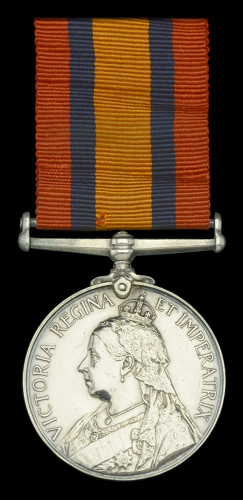
The rare Second Boer War medal awarded to Mr Frederic Villiers, the pioneering War Artist and Correspondent for the Illustrated London News amongst many others
Queen’s South Africa 1899-1902, no clasp (Mr. F. Villiers. “Illustrated London News”) good very fine £1,200-£1,600
This lot is to be sold as part of a special collection, A Fine Collection of Medals, the Property of a Lady.

View
Collection
Frederic Villiers was a pioneering British war artist, engraver, and correspondent who documented major military conflicts through on-the-spot sketches, written dispatches, and innovative battlefield photography and film. He was born in London on 23 April 1851, but spent his early childhood and schooldays in the north of France, specifically in Guînes, Pas-de-Calais, where he remained until 1869.
Villiers began his career in the 1870s, travelling to post-Commune Paris in 1871 under an alias to sketch scenes of destruction for panoramic illustrations, narrowly escaping arrest as a suspected spy. He gained prominence during the Servian-Turkish War of 1876, experiencing his first combat at the Battle of Sinitza on the Bosnia border, where he sketched amid shellfire and witnessed devastating infantry casualties. In the Russo-Turkish War of 1877-78, he covered the Russian defeat at Plevna and formed a close friendship with General Mikhail Skobelev, whom he later compared to historical figures like Napoleon and Wellington for his strategic brilliance. His work extended to the Anglo-Egyptian War of 1882, the Mahdist War in the Soudan 1884-85, including the battles of Tamaai and Abu Klea, where he sketched from within infantry squares under intense enemy fire, and the Second Boer War 1899-1900), attached to the Kimberley relief column under Lieutenant General John French.
Renowned for his bravery, Villiers often risked his life to capture authentic scenes, dressing in practical attire like a Wolseley jacket and Stanley-style cap while carrying sketching tools into battle; he was credited with early innovations such as using a bicycle for mobility and a cine-camera on the front lines. His illustrations appeared in prominent publications including The Graphic, Black and White, The Standard, and The Illustrated London News, and he produced annotated pencil-and-watercolor sketches of key moments, such as the surrender of Boer General Piet Cronje at Paardeberg Drift and the relief of Kimberley. Later, Villiers lectured on his experiences across North America and Europe, earning acclaim for his vivid depictions of soldiers' valour and the human cost of war, while collecting artifacts from campaigns, like Afghan rifles and Egyptian divans that filled his London studio. He published memoirs such as Peaceful Personalities and Warriors Bold (1907) and Villiers: His Five Decades of Adventure (1921), cementing his legacy as one of the Victorian era's most flamboyant and respected chroniclers of global conflict.
Frederic Villiers died on 5 April 1922, in London after a prolonged illness, at the age of 70. His passing marked the end of a prolific career that had significantly shaped visual journalism, though much of his recognition came posthumously through archival preservation and scholarly re-evaluation. He served as the model for Rudyard Kipling's character Dick Heldar in the novel The Light That Failed (1891).
Sold with copied ‘War Correspondents’ medal roll extract and other research.
Share This Page