Auction Catalogue




 Create new list
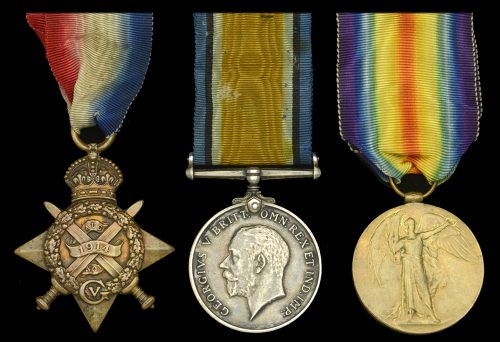
Three: Private M. E. Durrington, King’s Shropshire Light Infantry, who was twice wounded in action on the Western Front
1914 Star (9425 Pnr: M. E. Durrington. 1/Shrops: L.I.); British War and Victory Medals (9425 Pte. M. E. Durrington. Shrops. L.I.) very fine (3) £80-£100
Maurice Edgar Durrington, a bricklayer, was born in the Parish of Long Sutton, Lincolnshire, around 1890, and enlisted in the King’s Shropshire Light Infantry at Hyde on 26 April 1910. Transferred from Tipperary to France with the 1st Battalion, Durrington disembarked at Saint Nazaire on 10 September 1914 and was soon in action at Chemin des Dames in support of the hard pressed British Expeditionary Force. Sent to Le Quesne Farm and defensive positions at Bois Grenier, the Battalion suffered 55 killed, 79 wounded and 11 missing between 20-25 October 1914, representing 10% of strength in less than a week.
Remaining in the Armentieres Sector, the 1st Battalion spent the spring and summer of 1915 on trench holding operations. Deployed to Hooge in July 1915, they were present when the Germans successfully captured the British front line trenches using liquid fire. A few days later, on 9 August 1915, the British attempted to attack and recover the lost ground, including a large mine crater and 1000 yards of trench; the assault proved a success, but with high casualties to the 1st Battalion of 41 killed and 169 wounded, including Durrington.
Recorded as suffering a shell wound to the arm 10 August 1915, Durrington was evacuated home to England for medical treatment. He returned to the Western Front just a week before the opening engagements of the Battle of the Somme, later joining his comrades in the trenches opposite Beaumont-Hamel on 15 August 1916. Fighting alongside the 8th Battalion, Bedfordshire Regiment, Durrington took part in the capture of the Quadrilateral and ‘mopping up’ operations near Bourleaux Wood. He was subsequently wounded again to the arm on 22 March 1918 at Queant, attempting to hold back waves of storm troopers during the German Spring Offensive; the Battalion War Diary reports 21 officers and 492 other ranks as casualties during a desperate 2-day defensive action. He survived the campaign and was discharged in April 1919.
Sold with regimental cap badge and copied Army Service Record.
Share This Page