Auction Catalogue




 Create new list
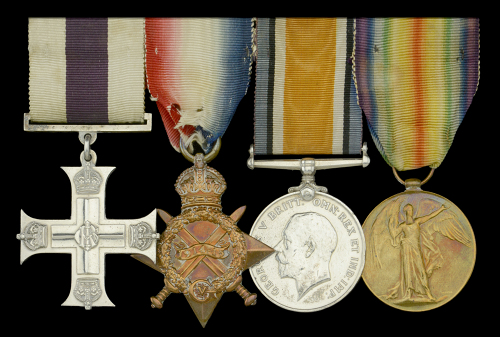
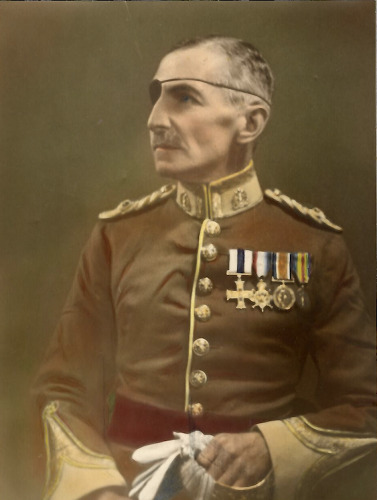
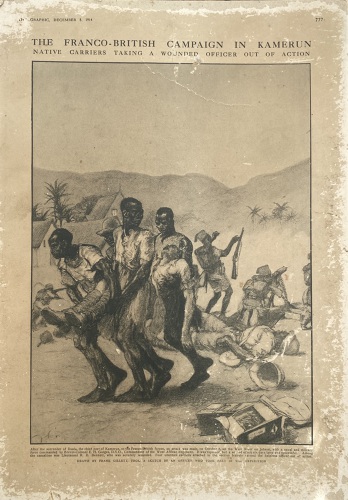
A very good and well documented Great War ‘Western Front’ M.C. group of four awarded to Captain R. D. Bennett, Middlesex Regiment, who received a gunshot wound to his mouth in West Africa during the Cameroons campaign, at the Battle of Jabassi in October 1914 whilst attached to the West African Regiment, his evacuation from the field becoming the subject of a sketch published in The Graphic in December 1914. Upon recovery, he was further injured during action near Hill 60 on 9 February 1915, and for his gallantry was afterwards recommended for a D.S.O.
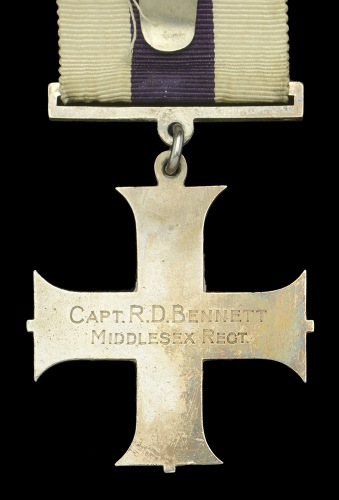
Military Cross, G.V.R. the reverse contemporarily engraved ‘Capt. R. D. Bennett Middlesex Regt.’; 1914-15 Star (Lieut. R. D. Bennett. Midd’x. R.); British War and Victory Medals (Capt. R. D. Bennett.) mounted for wear, contact marks, otherwise very fine (4) £1,400-£1,800
M.C. London Gazette, 30 January 1920.
Richard Douglas Bennett was commissioned into the Middlesex Regiment on 29 August 1906, serving in India with the 3rd Battalion before being attached to the West African Regiment in Sierra Leone from 11 May 1910. Serving at the start of the Great War in the Cameroons theatre as a Machine Gun Officer, he received a gunshot wound to his mouth at the Battle of Jabassi in October 1914. His diary, within the Imperial War Museum archives notes, ‘I went to my gunners and found them coming along under my white N.C.O. Wade. I took them up to a little knoll, with two or three tin sheds on it. so to hold (the) field of fire. I handed over one gun to Wade, and took the other myself. Got him mounted, the ammunition all handy, the ammunition carriers working splendidly. I fired the gun myself, as I wanted to make quite certain. After a couple of belts at a German gun on my immediate front, I should say not for than 3 to 4 hundred yards off. It stopped firing, and either shifted it or it had been put out of action. I hope the latter. I switched onto another target then, about 800 ‘to 900’ off. Heartbreaking work shooting at a well concealed target with a guessed range and you can’t see the strike of your bullets. I put my native N.C.O. on the gun and went around to see how Wade was getting along. He was getting along fine, except the poor old nut was standing up exposing himself as much as he could. I told him about that and then went back to my own guns and got quipped on the way back. A proper knockout. Andrews and Leach carried me to a bit of bush. I was more or less conscious, but I couldn't move much... Towards evening, as I judged by the light, I found a couple of native soldiers left with me looking after me. I found myself clinging to one of their legs. I insisted on them carrying me out of it. I’d no wish to spend a night in the bush I intimated by signs of course, being shot through the mouth, I wasn’t able to talk like a father to them. We got back all right. I remember them dropping me in a swamp, and I was mad as hell. Then Booth, an R.A.M.C. man, bunged me up with morphia and I went back in a dugout boat to Duala, where I had the luck to have Johnson, a Nigerian Medical Service man as surgeon. Johnson told me my face was an absolute nightmare. It was nearly three days before I landed up on the hospital. so I must have been a little ‘fruity’.’
The report of Lt. Col. Vaughan, 24 October 1914 to Headquarters British Contingent on operations of 8 October 1914 at Judassi [sic], Cameroons, notes ‘I wish to bring to the notice of the O.C. British Contingent the names of the under noted Officers B.N.C.O.’s and Men whom I consider distinguished themselves on that date. Lieut. R. D. Bennett Commanding the Regimental Machine Gun Section behaved with great coolness keeping his men and carriers well in hand. It was necessary to endeavour to silence some of the enemy’s guns, and although there was no cover he brought his guns into action under a heavy cross fire, working them until both were put out of action, Sert. Wade being killed and himself severely wounded’. In a letter to the recipient dated 31 October 1914 Vaughan wrote ‘I send you an extract of my report of the 8th which concerns you. I consider you did excellent work and I hope that you may get some recognition from those above, which will help to compensate you for what you have been through. I also mentioned Pte. Fodi Kata, as shewn, I have made him a Lce. Cpl.’
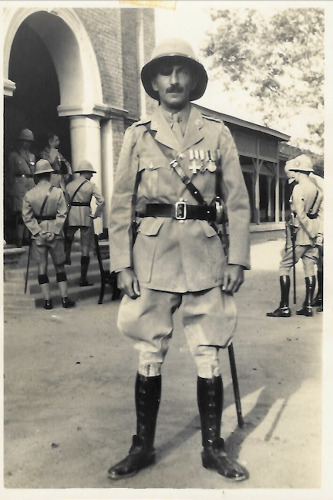
Advanced Captain on 11 December 1914, and upon recovery at home, he rejoined the 3rd Battalion of his parent regiment serving on the Western Front from 10 January 1915 commanding the machine gun section, and was again wounded on 9 February 1915, when serving as the Battalion Maxim Gun Officer during action near Hill 60. An extract of a letter sent to the recipient’s father on 17 June 1919 details the action, including ‘Your son’s conduct was magnificent beyond words, he personally kept cleaning the mud clogged Maxim Gun by sitting up on the parados clear of the mud in full view of the Germans. I had to order him under cover after the gun had been twice knocked out of his hands by bullets and his clothing pierced with bullets. He and I and the splendid men held that accursed place till the evening of the 9th, when your gallant lad collapsed from strain and frostbite. I sent him back to the support trench. His conduct was worthy of the VC. and I told Col. Stephenson so. The losses were 1 Officer, 22 men killed, 1 Officer, 33 wounded or frostbitten, out of a total of 3 Officers and 64 men.’ After recovery at Home, he saw further service in the Balkans theatre from 2 May 1916 to 8 August 1916, and the Egyptian theatre from 19 March 1916 to 1 May 1916. Post War, he continued to serve and was advanced Major on 15 September 1925, later serving as a 2nd Grade Staff Officer under Colonel The Viscount Gort V.C. in Shanghai and Japan.
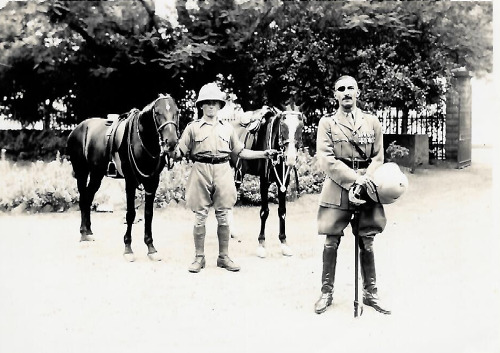
Sold with detailed copied research, original photographs, a page from The Graphic detailing his evacuation at the battle of Jabassi, detailed original and copied correspondence, and copied diary extracts.
Share This Page