Special Collections
Foreword
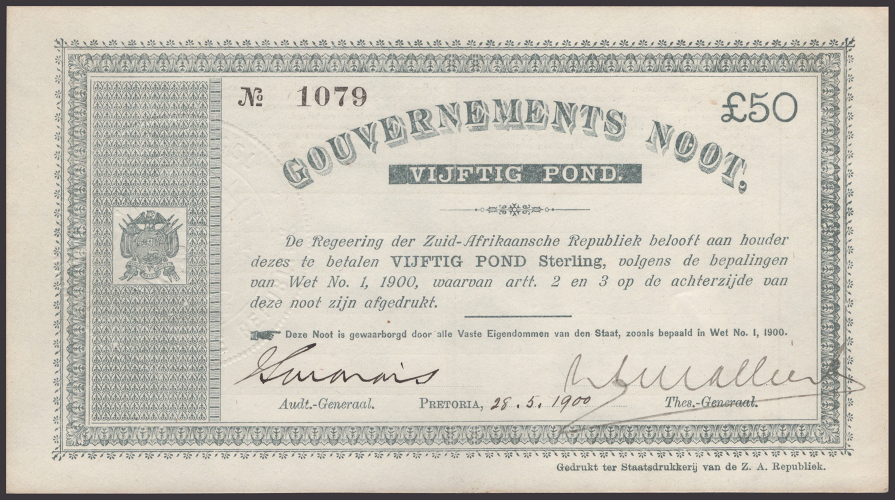
As an auctioneer, you are occasionally confronted by a collection so mind-boggling that you really don’t know what to say. When I was first shown this incredible collection of Boer War Gouvernements Noots, I was truly speechless. Varieties and dates I had never heard of or seen, incredible consecutive runs in grades I had thought impossible, and above all just massive quantities of notes!
Part One
The collection is so huge (around 200 notes) that we have split it into three parts. This first part includes most of the notes issued in Pretoria in 1900. While it does not include every single possible variety of these notes, it comes closer than any other collection I have ever seen, with more than 50 lots, most of which are different varieties. The level of concentration required to catalogue this collection was considerable (some would say extreme!) so please do forgive any small errors you may encounter. Please look on our website for additional images of the position of the watermarks and other important details.
Subsequent auctions will include all the notes issued in Pietersburg, and then all the notes issued in Ta Velde, along with a remarkable selection of errors and other notes that don’t fit with the general issues. I really hope you all enjoy this showcase of what decades of collecting can achieve, and that this catalogue does justice to both the collection, and the collecting ‘Velde’ in general.
Best of luck with your bids,
Andrew
Part Two
The second part of this remarkable collection of Boer War Zuid-Afrikaansche Republiek Notes consists entirely of notes issued in Pietersburg in the early months of 1901. All denominations were issued in varying quantities in February, March and April, and on a wide variety of paper types with an almost bewildering array of watermarks. Adding to the immense number of varieties was the initial misspelling of the word ‘uitgeloot’ as ‘uitgelost’ on the reverse of the note, and its subsequent correction, in addition to a huge variety of cancellations and hand stamps from many different locations.
Some of the issues in this section had almost comically low issuance numbers. The higher denominations are particularly difficult, with only 180 of the April £100 notes issued, 300 £50’s issued in April and 100 £20’s issued in February and March. The most remarkable by far, however, is the £10 dated March, of which only 20 were ever issued. Of course, even fewer examples of many of these are known today, with most survival numbers being low double figures, and some as low as two or three known copies. Where possible, we have noted the known issuance and surviving population in the descriptions so bidders can see how truly rare many of these notes are.
As ever, we hope you all enjoy these remarkable notes, and for those of you bidding, we wish you the best of luck with your efforts to add them to your own collections.
Andrew
Part Three
The third part of this wonderful collection consists of two main groups of items. Firstly, there are the Žfinal issues of the Boer War Zuid-Afrikaansche notes, issued ‘in Te Velde’ - in the Žfield. These notes were printed towards the end of the war, when the Boer forces were in retreat, and they are made on the crudest paper, and with cobbled together and ill-suited equipment. The print quality is by far the lowest, and Žfinding examples of some denominations in nicer condition is extremely difficult. This series was only printed in denominations of £1, £5 and £10, and some of the months of issue are extremely rare. The Žnal lot of the section, for example, has a print run of only 400.
Secondly, the final part contains a huge variety of more errors and other such curiosities from the Pretoria, Petersburg and Te Velde issues. Some of these errors may be fairly minor, such as amended serial numbers or incorrect alignments, but others are more spectacular, such as an entirely inverted reverse printing! There are also examples of things such as eld graœti, thread-sewn repairs, and unusual cancellations.
These eclectic items are all extremely rare, and were a lot of fun to work on and catalogue. I hope you all enjoy them as much as I did. As we come to the end of this magnificent collection, I can only wish all of you the best of luck with your bidding for the final time.
Andrew
Share This Page