Special Collections




 Create new list
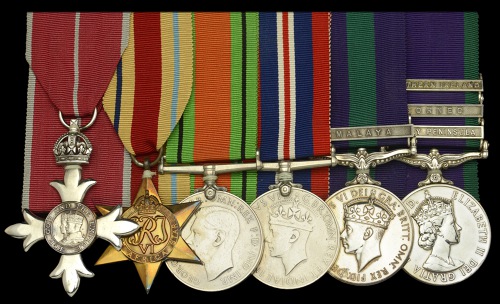
A post-War M.B.E. group of six awarded to Major J. H. A. Bryden, Royal Army Pay Corps, late Royal Artillery
The Most Excellent Order of the British Empire, M.B.E., (Military) Member’s 2nd type, breast badge, silver; Africa Star; Defence and War Medals 1939-45; General Service 1918-62, 1 clasp, Malaya, G.VI.R. (Capt. J. H. A. Bryden. R.A.); General Service 1962-2007, 3 clasps, Malay Peninsula, Borneo, Northern Ireland, unofficial retaining rods between clasps (Major J. H. A. Bryden. R.A.P.C.) mounted court-style as worn, nearly extremely fine (6) £300-£400
This lot was sold as part of a special collection, A Collection of Medals to the Royal Army Pay Corps.

View
Collection
M.B.E. London Gazette 12 June 1976.
The original Recommendation, dated 14 November 1975, states: ‘Major Bryden retires from the Army in April 1976 having completed 36 years of dedicated service. He applied for and was granted an extension of one year to his service in order that he might see the 1st Battalion, Scots Guards through its third tour in Northern Ireland, all of which he has attended, and also cover the move from Germany to London. This is indicative of his devotion to duty, even in his 56th year.
He was commissioned into the Royal Artillery in 1939 and served with the Indian Army for five years, seeing active service in North Africa. In 1957, when a Deputy Assistant Adjutant and Quartermaster General on the staff of a formation headquarters, he took the unprecedented step of transferring into the Royal Army Pay Corps. He did this against the wishes of his superior officers, for he was both successful and staff trained, but with foresight and determination Major Bryden pursued his course because he realised that there was at that time a superfluity of officers of his age and seniority in the Royal Regiment of Artillery, and he had to take into account reasons of personal necessity.
He has served the 1st Battalion Scots Guards as the Paymaster in an exemplary way for 12 years. He has been with a battalion on active service in Malaysia and Northern Ireland, and was in Sharjah unaccompanied for nine months.
During the last decade, he has experienced many changes in the Battalion, and within his own Corps and its methods. He has unfailingly adapted to them all and given himself tirelessly to his work, in which he has a long established reputation second to none.
A person of great character and splendid sense of humour he is held in respect and earns a loyalty of everyone with whom he comes in contact. He has devoted a large proportion of his life to the good of battalion and the welfare of his soldiers, and the number of Scots Guardsmen, now scattered far and wide, who owe him a debt of thanks is very large.
He is always prepared to give his wise council, based on his expert knowledge and his wealth of experience, to anyone who seeks it, not only within the Battalion but also from outside it. He has willingly undertaken many tasks beyond the call of his normal duty and fulfilled them in an admirable way. When he retires and era will pass, but it is most appropriate that his son is to perpetuate his name in the Regiment to which he has given such outstanding service. This long service is synonymous with a selfless devotion to duty which richly merits official recognition.’
John Hewgill Anderson Bryden was born in Shoeburyness, Essex, on 30 April 1920 and was commissioned Second Lieutenant in the Royal Artillery on 3 July 1939. Promoted Lieutenant on 3 January 1941; Captain on 1 July 1946; and Major on 3 July 1952, he attended the Staff College, Camberley, from 23 January to 16 December 1953 and was appointed a Deputy Assistant Adjutant and Quartermaster General in February 1954. He transferred to the Royal Army Pay Corps on 9 January 1957, and was posted as Paymaster to the 1st Battalion, Scots Guards in June 1964. He retired on 30 April 1976, and was appointed a Member of the Order of the British Empire in that year’s Birthday Honours’ List. He died in Edinburgh on 12 January 2008.
Sold with copied research.
Share This Page