Special Collections




 Create new list
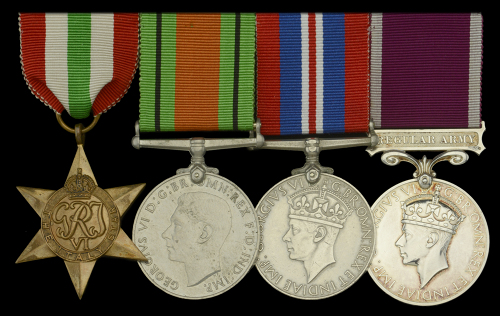
Four: Captain G. A. Jury, Royal Signals, who was seconded to the Secret Intelligence Service (later MI6) Section VIII during the Second World War for service at Whaddon under Colonel Richard Gambier-Parry, and later at Hanslope Park with the Diplomatic Wireless Service (DWS); as a Civil Servant employed post-War as a ‘Post Office Engineer’ he subsequently worked with the Government Code and Cypher School and Government Communications Headquarters (GCHQ)
Italy Star; Defence and War Medals 1939-45; Army L.S. & G.C., G.VI.R., 1st issue, Regular Army (Lieut. G. A. Jury R. Sigs.) mounted for wear, rank officially corrected on last, good very fine and better (4) £240-£280
This lot was sold as part of a special collection, Medals from the Collection of Peter and Dee Helmore.

View
Collection
George Alfred Jury was born in Stoke, Devonport, on 10 August 1908, the son of a Moulder at H.M. Dockyard, Devonport. Recognised as an intelligent lad he successfully passed the competitive and demanding examination for acceptance to the Signals Training College and was attested for the Royal Corps of Signals at Plymouth, Regular Army (All Arms) on 23 August 1923. Aged 15 years 13 days he was posted 2315728 Boy to the Signals Training College, Maresfield Park. Awarded his 3rd Class Certificate of Education at Maresfield that month and his 2nd Class Certificate two weeks later, he passed the 1st Test for Boy Operator Wireless on 12 March 1924, the 1st NEW Test for Boy Operator Wireless the following December and the 2nd Test for Boy Operator W/T in May 1925, and was awarded his 1st Class Certificate of Education at Maresfield whilst still aged only 16. Passing his 3rd Test for Boy Operator W/T on 15 February 1926 he reached the age for ‘man service’ and was posted as Signalman, Trade Operator W/T Group B Class III on the 10 August 1926 and transferred to ‘D’ Troop Cavalry Signals Aldershot the following month.
Jury embarked at Southampton for Egypt per HT City of Marseilles on 4 November 1927 and was posted to No 1 Company Egypt Signals transferring to No 3 Company Egypt Signals in January 1928. Returning home he was posted to 5th Divisional Signals in January 1933 and elected to extend his present terms of service to complete 12 years with the Colours on 16 March 1934. Appointed Lance Corporal he was posted back to Egypt where he joined ‘F’ Troop Cavalry Divisional Signals 12th Royal Lancers on 9 January 1936. Returning home he was promoted Corporal Royal Signals, 12th Royal Lancers on 18 June 1937.
At this stage of his career Jury must have come to the attention of Colonel (later Brigadier) Richard Gambier-Parry and his staff as he was (prematurely) discharged to Pension on termination of engagement on 9 August 1938 having served 14 years 352 days with his conduct shown as ‘Exemplary’. Just prior to his discharge he is shown as attesting for Section D of Army Reserve at Government Training Centre, Redbridge, Southampton on 18 July 1938 aged 29 and recorded as a Post Office Telephone Fitter residing in Plymouth. Posted 2315728 Corporal, Royal Signals Section ‘D’ Reserve only to be struck off the strength Section ‘D’ on 9 December 1938 under authority War Office Letter 6 March 1939, this being the date it is assumed he officially joined the staff of the Secret Intelligence Service (later MI6) Section VIII at Whaddon under Colonel (later Brigadier) Richard Gambier-Parry.
Next attesting for the Territorial Army at Whaddon with his papers clearly marked ‘Not Paid from Army Funds’ on 16 August 1940, Jury was posted 2315728 Signalman (Rank Local Sergeant), Special Signal Unit No 1, Whaddon on the same date. Posted to Special Communication Unit No 3 Hanslope Park on 23 November 1942 he was discharged for the purpose of being appointed to an Emergency Commission in the Royal Signals (Not Paid from Army Funds) on 21 December 1942. Commissioned in the Royal Signals as Second Lieutenant (without pay and allowances from Army Funds) the following day, he was still with the Special Communication Unit No 3, Hanslope Park, before being promoted War Substantive Lieutenant and attached to the Special Communication Unit No 1 for all purpose at Whaddon on 22 December 1942. Posted from Special Communication Unit No 3 to Special Communication Unit No 1 in March 1943 and then to Special Communication Unit No 2 on 26 January 1945, Jury was further promoted Acting Captain on 8 March 1945 and embarked UK on 4 April 1945. At this stage his records are not clear; however, it is likely he was working with ISLD (Inter Services Liaison Department) HQ in Cairo. Posted then to the ISLD unit based in Bari on the Adriatic Coast and especially concerned with working to agents in Yugoslavia and Northern Italy to qualify for award of the Italy Star as shown in his service records.
Promoted Temporary Captain on 8 June 1945, Jury disembarked UK from Special Duties Overseas on 21 August 1945 before resuming his Special Duty Overseas on 27 February 1946. He disembarked UK from Service Overseas, Special Communication Unit on 10 September 1946 and was struck off Unit Strength Hanslope Park on 4 October 1946 to commence release leave at his home address at Billington Road, Leighton Buzzard, Bedfordshire. Finally released from Service 16 December 1946 he was issued with the Italy Star, Defence and War Medals. Awarded his Long Service and Good Conduct Medal (Military) in the London Gazette of 6 December 1947 he was officially appointed Skilled Worker Class II, Bedford Telephone Area, in March 1949; presumably following his release from service in December 1946 he continued his service with MI6 at Hanslope Park with the Diplomatic Wireless Service (DWS) under cover employment as a ‘Post Office Engineer’ and was working with the Government Code and Cypher School which in 1946 became known as Government Communications Headquarters (GCHQ). Relinquishing his Commission and granted the Honorary Rank of Captain on 15 March 1954 whilst still residing at Leighton Buzzard, Bedfordshire, he died at Leighton Buzzard on 19 November 1977, aged 69, and is recorded as a Post Office Engineer (Retired).
Sold with copied service record confirming medal entitlement and further research including a copy of The Secret Wireless War – The Story of MI6 Communications 1939-1945 by Geoffrey Pidgeon who served with Special Communications and DWS 1942-1947 published by the author in 2008 in which the significance of the term ‘Not Paid from Army Funds’ is explained.
Share This Page