Special Collections




 Create new list
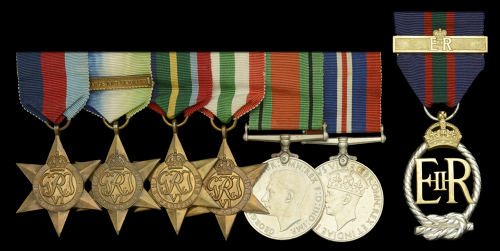
Seven: Lieutenant-Commander E. G. Wakefield-Gush, Malayan Royal Naval Volunteer Reserve, later Royal Naval Reserve, who as a Lieutenant in H.M.S. Duke of York was present at the sinking of the German Battlecruiser Scharnhorst during The Battle of the Cape on 26 December 1943; was involved in Mine-sweeping Juno Channel during the D-Day assault in June 1944; and engaged and sunk Submarine U.300 off Cadiz in February 1945
1939-45 Star; Atlantic Star, 1 clasp, France and Germany; Pacific Star; Italy Star; Defence and War Medals 1939-45; Royal Naval Volunteer Reserve Decoration, E.II.R., the reverse inscribed ‘Lt. Cdr. E. G. Wakefield-Gush, M.R.N.V.R., 12-10-54’, with ‘E.II.R.’ Second Award clasp, this undated, the first six mounted as worn, the last loose in Royal Mint case of issue, good very fine and better (7) £400-£500
This lot was sold as part of a special collection, Medals from the Collection of Peter and Dee Helmore.

View
Collection
Richard Schweder Collection, Dix Noonan Webb, December 2008.
Edward Gibbon Wakefield-Gush was born at Cumberland Place, Southampton on 5 June 1914, the son of Engineer Commander Arthur Sydney Gush, O.B.E., R.N. (Retd) and Marie Constance Gush, née Wakefield. On completion of his education he was employed in 1939 by The Dunlop Rubber Company, Malaya as the Assistant Manager Johol Estate, North Sembilan and later moving to the Johore Labis Estate. Commissioned Acting Sub-Lieutenant Straits Settlements (Singapore) Royal Naval Volunteer Reserve in H.M.S. Sultan on 30 October 1939 he was mobilised on 30 January 1940 and recorded as Sub-Lieutenant in H.M.S. Tapah in April 1940. Next shown as Lieutenant in H.M.S. Edinburgh Castle (Accommodation Ship, Freetown, Sierra Leone) and serving with 108 M/L Flotilla in West Africa on 30 November 1941, he transferred to the Royal Naval Volunteer Reserve as Temporary Lieutenant on 24 July 1942.
Appointed Temporary Lieutenant in H.M.S. Duke of York on 13 August 1943, Gush was present at the sinking of the German Battlecruiser Scharnhorst during The Battle of the Cape (North Norway) on 26 December 1943. He joined H.M.S. Recruit (Algerine Class Fleet Minesweeper) as Gunnery Officer (Temporary Lieutenant) and sailed from Portsmouth with Flotilla for clearance of Channel 8 ahead of 1st Assault convoys on 5 June 1944. H.M.S. Recruit swept Juno Channel arriving off Courseulles on D-Day H-Hours-Minus-Four (0335 hrs) on 6 June 1944 and continued minesweeping off Normandy during Build-up Phase part of Trout Defence Line being retained in the Forward Area for minesweeping during the period June to August 1944. That same year he adopted the hyphenated version of his surname.
Wakefield-Gush was deployed next with the Flotilla for Air Sea Rescue during the Arnhem airborne landings (Operation Market Garden) on 17 September 1944, followed by escort duty for the convoy of Landing Ships (Tank) during passage from Falmouth to Gibraltar on 17 February 1945. It was during this time that H.M.S. Recruit along with Pincher and Rifleman detected and engaged Submarine U.300 (Lt. Hein), in the North Atlantic west of Cadiz on 22 February 1945. U.300 surfaced and was scuttled by her crew of 4 officers and 37 ratings who were rescued by H.M.S. Recruit and landed at Gibraltar. Lieutenant Wakefield-Gush submitted his report dated 23 February 1945 to the Admiralty on information gained from the prisoners of U-Boat 300. Recruit continued on her passage to India via the Red Sea in April 1945 to be deployed with the Flotilla and the Indian 37th Minesweeping Flotilla as Force 63 prior to the planned landings in Rangoon (Operation Broom) on 24 April 1945 and was nominated for minesweeping operations in support of planned invasion of the Malayan Peninsula (Operation Zipper) in July 1945, later carrying out a special mine clearance operation off Pukhet Island.
Wakefield-Gush was transferred to H.M.S. Lanka (RN Base, Columbo, Ceylon) in July 1945 and to H.M.S. Hathi (RN Depot, Delhi) in April 1946. Whilst at Delhi he was involved in a car smash in a military Jeep on duty suffering mild concussion and multiple bruising. Taken onto the books of H.M.S. President I for Class ‘A’ release dispersal in January 1946 he was finally released on 17 May 1946 and returned to Malaya. Promoted to Lieutenant-Commander in the Malayan Royal Naval Volunteer Reserve on 1 November 1948, he was awarded his Royal Naval Volunteer Reserve Decoration as Lieutenant Commander, Malayan Royal Naval Volunteer Reserve on 12 October 1954. He retired from the Dunlop Rubber Company, Malaya and moved to Jersey in 1960. Transferring from the Malayan Royal Naval Volunteer Reserve to Permanent Royal Naval Reserve in rank of Lieutenant-Commander on 19 September 1961 he was formally transferred for duty at Jersey as NCSO on 6 September 1962. Awarded an Additional Award Bar to the Royal Naval Volunteer Reserve Decoration in January 1966 he transferred to the Special Branch Royal Naval Reserve in July 1966 and was placed on the Retired List on 31 December 1971. He died at St Helier, Jersey, on 5 February 1972, aged 57.
Sold with copied service record obtained from the Admiralty confirming medal entitlement and considerable further research including detailed correspondence and photographs taken on board H.M.S. Recruit and received from a fellow Royal Naval Reserve officer who served on H.M.S. Recruit with Wakefield-Gush; a photograph of H.M.S. Duke of York; a copy of a report written by Lieutenant Wakefield-Gush on the information gathered from the prisoners of U-300; testimonial from Captain F. E. W. Lammert, Malayan R.N.V.R., dated 16 February 1960, providing brief details of the recipient’s career; M.O.D. notification of the award of a clasp to the R.N.V.R. Decoration, 1 December 1965; and forwarding slip for the same, dated 6 December 1966.
Share This Page