Special Collections




 Create new list
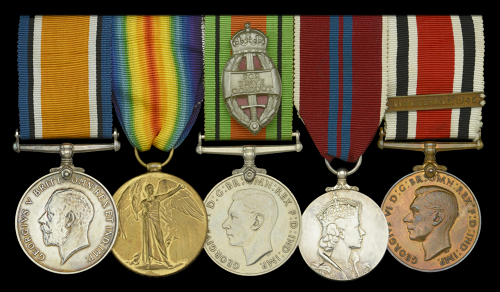
A Second War ‘Plymouth Blitz’ King’s Commendation group of five awarded to Gunner G. H. Strathon, Royal Artillery, later Divisional Commandant, Plymouth Special Constabulary
British War and Victory Medals (206232 Gnr. G. H. Strathon. R.A.); Defence Medal; Coronation 1953, unnamed as issued; Special Constabulary Long Service Medal, G.VI.R., 1st issue, 1 clasp, Long Service 1945 (Inspr. George H. Strathon); with King’s Commendation for Brave Conduct plastic badge for civilians, mounted as worn; together with the recipient’s riband bar, nearly extremely fine (5) £400-£500
This lot was sold as part of a special collection, Medals from the Collection of Peter and Dee Helmore.

View
Collection
King’s Commendation for Brave Conduct in Civil Defence London Gazette 10 April 1942.
The original Recommendation states: ‘Inspector Strathon, who lived in a district of Plymouth which received most of the damage during a very heavy air attack on the 20th March, 1941, had just arrived at his home after having been on duty for many hours when the raid started. Almost immediately incendiary and high explosive bombs fell in large numbers in the vicinity and, without hesitation, Mr. Strathon left his home and extinguished many small outbreaks of fire in the neighbourhood.
A number of serious incidents occurred and owing to the breakdown of communications and the extraordinary demands on the various services Mr. Strathon found himself with little assistance to deal with these. He, however, organised rescue parties and until the arrival of regular police officers assumed control of all the incidents in the area. He continued to render valuable assistance and at great personal risk endeavoured to effect rescues from premises completely demolished by high explosive bombs and in which the work of rescue was rendered even more hazardous by fire, which, owing to the failure of the water supply, for a time, could not be checked.
Later, when a very limited water supply was available, Mr. Strathon, for many hours, worked hard and with no thought for his personal comfort on the many large fires which were burning in the district and it was undoubtedly, in no small measure, due to his efforts and example, that the fires in this area were not considerably more extensive than they were.
When Fire Brigade reinforcements arrived Mr. Strathon was able to give useful assistance in connection with the evacuation of areas rendered dangerous by the presence of unexploded bombs and he was on duty in this connection until relieved at about noon, having been continuously on duty since the commencement of the raid more than fifteen hours previously.
Inspector Strathon has since been on duty during the other heavy air raids on Plymouth and on each occasion has rendered sterling service. He is a man of ability and courage whose coolness, devotion to duty and disregard for his a safety and comfort, has made him a most valuable and respected officer of the Special Constabulary.’
George Henry Strathon was born in Charles, Plymouth in 1898. A Laboratory Tester he attested for the duration of the War into the Royal Regiment of Artillery on 5 June 1916 and was mobilised on 6 March 1917. Posted as a Gunner to ‘R’ Battery, Royal Horse Artillery, he embarked for India on 30 April 1917, and thence to Mesopotamia, being posted to ‘W’ Battery on 30 November 1917. Appointed Acting Paid Lance Bombardier in February 1919 he was discharged on demobilisation on 3 February 1920.
Strathon was enrolled into the Special Constabulary, Plymouth in 1938 and was recorded in the 1939 Register as Sergeant Special Constabulary City of Plymouth Police. As an Inspector he was recommended by the Plymouth Chief Constable for ‘Rescue work, fire fighting &c. at Plymouth during a very heavy air attack 20 March 1941’. He was presented with the Special Constabulary Long Service Medal by the Deputy Lord Mayor, chairman of the Watch Committee at Greenbank, HQ City of Plymouth Police on 25 March 1942, and his King’s Commendation was formally confirmed on 8 April 1942. Appointed Divisional Commandant, Plymouth Special Constabulary he was awarded the Queen Elizabeth II Coronation Medal in 1953. He died at Plymouth on 26 January 1961, aged 65.
Sold with extensive copied research including a copy of the Chief Constable’s award recommendation and five further pages of supporting witness statements confirming his bravery on 20 March 1941.
Share This Page