Special Collections




 Create new list
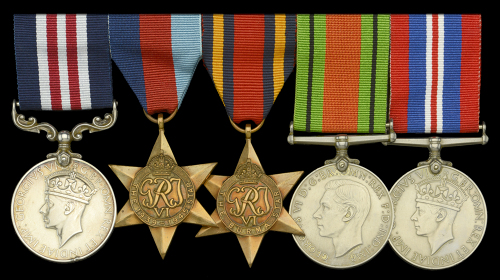
A fine Second War ‘Burma operations’ M.M. group of five awarded to Private S. E. Cann, Devonshire Regiment, for his ‘marked gallantry in action’ whilst successfully attacking a bunker at Nippon Hill on 11 April 1944 and killing four of the enemy
Military Medal, G.VI.R. (5628819 Pte. S.E. Cann. Devon R.); 1939-45 Star; Burma Star; Defence and War Medals 1939-45, mounted for wear, minor edge bruise to MM, otherwise nearly extremely fine (5) £1,000-£1,400
This lot was sold as part of a special collection, Medals from the Collection of Peter and Dee Helmore.

View
Collection
1 of 9 M.M.’s awarded to the Devonshire Regiment for services in the Burma theatre of operations.
M.M. London Gazette 27 July 1944:
‘In recognition of gallant and distinguished services in Burma.’
The original Recommendation, dated 25 April 1944, states: ‘For Marked Gallantry in Action. Private Cann displayed marked gallantry in the action on Nippon Hill – Tengnoupal on 11 April [1944]. He was a pioneer attached to the assaulting Company. He placed a beehive on the top of a bunker under fire. After the beehive had gone off he jumped into the bunker with his revolver to ensure that any enemy within the bunker were dead. When he came out Sergeant Green of the G/R Platoon saw 4 dead Japs in the bunker. ‘
Samuel Ernest Cann was born in Poughill, Stratton, Cornwall in October 1919. Employed as a Horseman on a farm at Broadwoodwidger, Devon he enlisted for the Territorial Army for the duration of the emergency on 17 July 1940. Posted initially to the 11th Battalion Devonshire Regiment, on completion of his training he was posted to the 1st Battalion on 8 February 1944, then stationed at Pynbon Sakan, Burma. Following the withdrawal from Ridge Camp to Imphal Plain the 1st Battalion laid out new positions in Kuntaung area on 9 March 1944 before moving to hold Devon Hill, east of Sibong Bridge later that month. Patrols commenced along the Mombi Track and followed with a withdrawal to Patiala Ridge on 3 April 1944. Next taking part in the attack and capture of Nippon Hill (Tengnoupal Peak) on 11 April 1944, it was here that Cann was awarded his Military Medal for his marked gallantry in action on that day.
Taking up positions on Patiala Ridge (Crete, Cyprus and Scraggy Hills) before relieving the 3/1 Gurkhas on Crete West, Scraggy and Malta Hills on 1 May 1944, the 1st Battalion defended and held the position against constant heavy Japanese attacks until relieved on 10 May 1944. The battalion sustained two hundred casualties, killed wounded and missing in these first ten days of May before being moved to Punjab Hill to recuperate. Moving next to Kameng later that month they then commenced their advance up the Iril Valley to cut enemy lines along the Ukhrul Road on 6 June 1944. After considerable privation and patrolling towards the Ukhrul Road they captured Lambui on 11 July at which stage the 1st Battalion was withdrawn from the line on the 17 July after 4 months’ constant fighting in jungle conditions.
The battalion subsequently moved to 80th Brigade concentration area at Wangjing and were granted a ‘leave period’. On return to duty they were inspected by H.E. The Viceroy of India, Field Marshal Wavell, at Wangjing on 7 August 1944 and it was following this inspection that Private Cann was decorated with the riband for his Military Medal by the Viceroy at a roadside investiture. The 1st Battalion left Wangjing for the Tamu-Kalemyo Road for road maintenance duties in mid-November 1944 before being ordered to march to Thazi to defend against Japanese threat up the Gangaw Valley at the beginning of December. At the end of the month they commenced their march into central Burma before crossing the Chindwin River at Kalewa on 1 January 1945 to form part of the Brigade assault on Monywa and its final capture on the 22 January. Occupying the Myaung area on the north bank of the Irrawaddy on 31 January they moved upriver to Myinmu and continued patrolling the riverbank prior to crossing the Irrawaddy River on 20 February 1945.
Continuing their advance via Kanlan and Talingon, the Battalion assaulted and captured Sinbyugon on 5 March 1945 prior to their last action in Burma when they captured Letpanpin on 30 March 1945. The battalion commenced a move to Pyiban for reorganisation and rest during April before emplaning at Meiktila Airfield to commence their move to India on 1 May. Flown to Imphal they moved by Motor Transport to Dimapur and crossing the River Ganges they arrived at Visapur Camp, east of Poona, for re-fitting on 13 May 1945.
Cann was appointed Unpaid Lance Corporal on 22 July 1945, and the battalion received news of the Japanese surrender on 15 August. Appointed Paid Acting Corporal in November the battalion embarked MA Sibajak with 6th Infantry Brigade disembarking at Singapore on 22 December 1945. Stationed at Kluang to guard Japanese prisoners of war, Cann was promoted War Substantive Corporal on 30 January 1946 prior to embarking for Home to commence his Release and Overseas Leave on 8 March 1946. Released to Class ‘B’ W/T Reserve on 29 March 1946 after 5 years and 255 days’ service, he was finally discharged from Reserve Liability in June 1959. He died in Plymouth on 7 June 1997, aged 78.
Sold with copied research.
Share This Page