Auction Catalogue




 Create new list
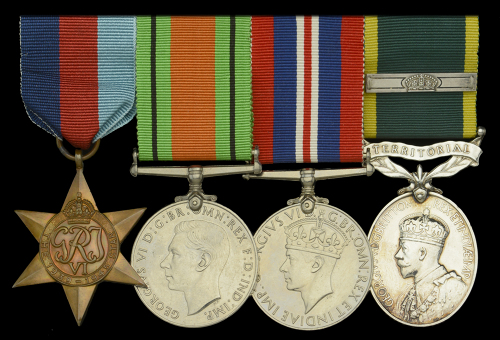
Four: Quartermaster Sergeant S. J. Ridler, Devonshire Regiment, who, having been evacuated following the fall of Dunkirk, was later wounded but survived the sinking of the SS Arandora Star on 2 July 1940; a victim of Gunther Prien and the U-47, the ex-Blue Funnel ship was laden with German and Italian internees, bound for Canada, of whom over 600 lost their lives
1939-45 Star; Defence and War Medals 1939-45; Efficiency Medal, G.V.R., Territorial, with one Additional Award Bar (5613657 Pte. S. J. Ridler. 4-Devon R.) mounted for wear, nearly extremely fine (4) £240-£280
This lot was sold as part of a special collection, Medals from the Collection of Peter and Dee Helmore.

View
Collection
Sydney John Ridler was born at Withycombe Raleigh, Exmouth on 30 November 1904 and attested for the 4th Battalion Devonshire Regiment (Territorial Army) at Exmouth on 14 February 1924, signing the Agreement for Service outside the United Kingdom after Embodiment. He attended each of the Annual Camps from 1924 to 1939, and was advanced Sergeant July 1933. Awarded his Efficiency Medal (Territorial) per Army Order 154 of August 1936 he was posted to the 8th Battalion Devon Regiment August 1939. Embodied for Second War service with the 8th Battalion Devonshire Regiment on 1 September 1939, he embarked with the British Expeditionary Force on 8 May 1940 and was evacuated from Dunkirk on 31 May 1940.
Ridler embarked at Liverpool for Canada as part of Military Guard in the SS Arandora Star on 1 July 1940. The SS Arandora Star was torpedoed by U-47 (commanded by Gunther Prien, of H.M.S. Royal Oak notoriety) and sunk 75 miles west of Bloody Foreland, Ireland on 2 July 1940 with a total of 745 persons lost out of the 1667 carried (Crew, Military Guard, German and Italian Internees and German Prisoners of War). Hocking’s A Dictionary of Disasters at Sea states:
‘The liner was under the command of Captain Moulton and carried 1,178 German and Italian internees proceeding to Canada, the remainder consisting of 176 crew and 254 troops charged with the duty of guarding the prisoners. Immediately the torpedo exploded there was panic among the Germans and Italians, who fought each other with ferocious savagery. In attempting to rush the boats scores were forced overboard and drowned …’
Sergeant Norman Price, a survivor, later recalled:
‘I could see hundreds of men clinging to the ship. They were like ants and then the ship went up at one end and slid rapidly down, taking the men with her … Many men had broken their necks jumping or diving into the water. Others injured themselves by landing on drifting wreckage and floating debris near the sinking ship … ’.
Ridler received injuries to his head during the sinking. On recovery he was posted from the Prisoner of War Camp Details to HQ Western Command, Chester on 5 August 1940 and was promoted Quartermaster Sergeant on 9 November 1942. He was discharged Permanently Unfit for any form of Military Service with 30% disability on 14 January 1943, presumable as a result of his injuries following the sinking of the SS Arandora Star, having served 18 years and 335 days. He received an Additional Award Bar to his Efficiency Medal per Army Order 45 of March 1950, and died in Exmouth on 12 February 1988, aged 83.
Sold with copied service record confirming medal entitlement and other research and including extensive copied research regarding the sinking of SS Arandora Star.
Share This Page