Lot Archive


 Create new list
The Warner ‘Gresham Grasshopper’ Seal Ring
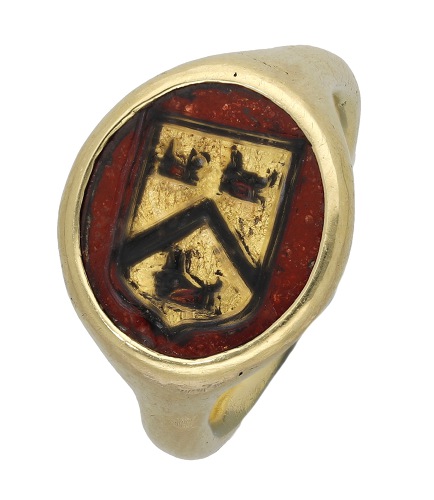
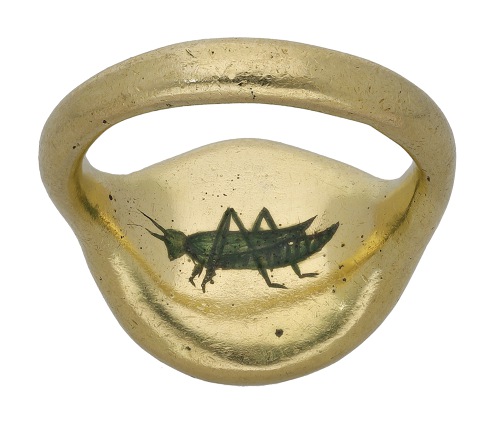
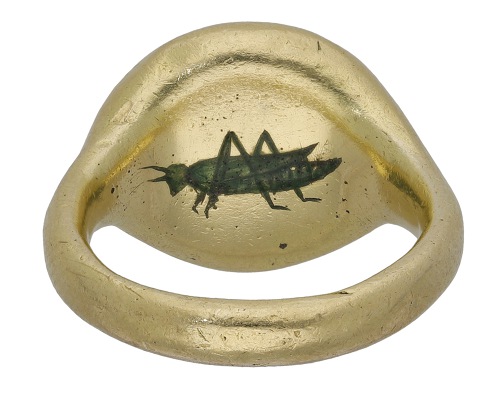
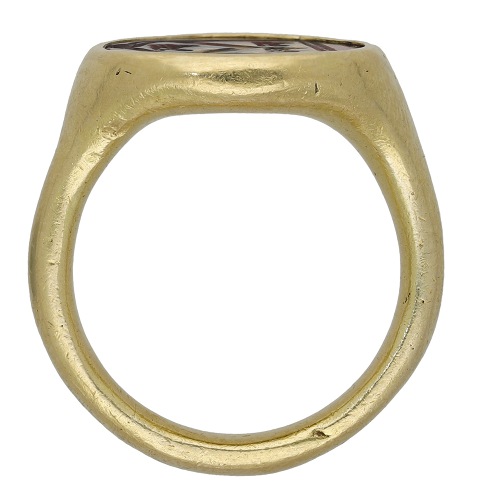
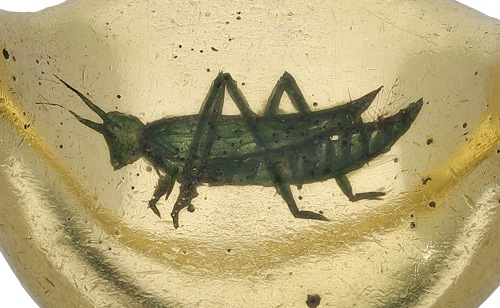
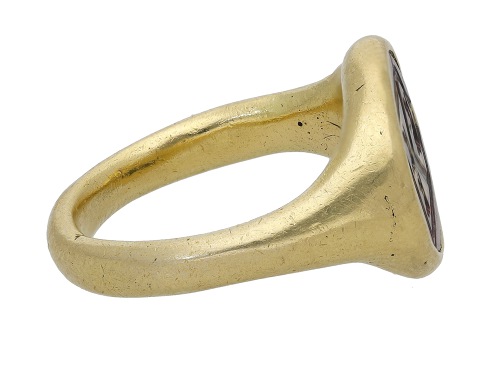
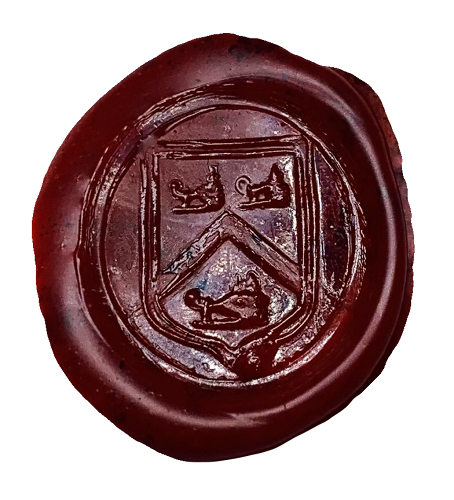
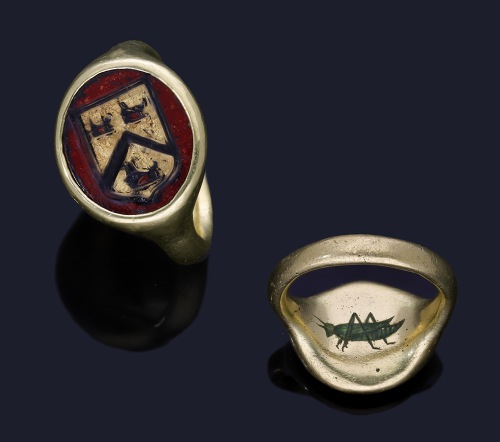
An important 16th century gold signet ring, circa 1560-1575, the oval crystal bezel intaglio carved with the coat of arms of Warner, with tinted foil behind to colour: Or a chevron between three boars’ heads couped sable, in a closed gold mount with tapered shoulders, the underside of the bezel engraved with a grasshopper in green enamel, weight 14.8gm, ring size Q. £10,000-£15,000
This, until now unrecorded ring, is one of a series of ‘Gresham Grasshopper’ seal rings, gifted by the great Tudor financier Sir Thomas Gresham between the years 1560-1575. This ring was inherited through a private family from the 19th century, thence by descent, until circa 2010.
Sir Thomas Gresham (1519-1579)
The Gresham family were an old Norfolk family, merchants and financiers by trade. Sir John Gresham (1495-1556) worked for Henry VIII, Cardinal Wolsey and Thomas Cromwell.
The young Thomas Gresham, following in his family’s footsteps, served his apprenticeship as a merchant under his uncle Sir John Gresham, dealing principally in woollen cloth and other luxury textiles such as silks and velvets. However his true talents lay elsewhere, like his father Sir Richard Gresham, in making deals in foreign exchange and arranging finance. His father “taught him some of the secrets of exchange dealing in Lombard Street and Antwerp” (Guy, J., p.13). By the 1530s Thomas began working and training within the family business, by this time the Gresham family firm were the largest shippers trading out of London. In 1543, at the age of just 24, Thomas was, again following family tradition, admitted as a liveryman of the Mercers’ Company, leaving England later that year to pursue business in the Low Countries. Quickly earning respect for his adept and skilful play of the financial markets, his trade took him regularly to Antwerp, the principal trading port for cloth in the European markets, and by the 15th century the “commercial capital of Northern Europe” (Guy. J., p.19). Here he began to undertake financial arrangements on behalf of Henry VIII, including smuggling over £30,000 of gold and silver coins into Bologne to pay the king’s mercenaries based in Antwerp.
A shrewd and astute businessman, Thomas Gresham skilfully kept out of the religious fever sweeping back and forth across 16th century Europe and this determined neutrality allowed him to maintain his role as financial agent to the Crown, not only to Henry VIII, but Edward VI, Mary and finally Elizabeth I, negotiating foreign and domestic loans, advising on financial matters, and manipulating the exchange rates to allow him to restructure and reduce the crown debt. Under Elizabeth he was also appointed as ambassador to the Court of Margaret of Parma, Governor of Netherlands.
In 1565 Thomas Gresham agreed to finance and oversee the construction of the Royal Exchange, largely modelled on the Antwerp Bourse, on a site between Lombard Street and Cornhill, a grand and appropriate venue for him and his fellow merchants to conduct their business. After his death in 1579, in his will Thomas Gresham left the Royal Exchange in trust, to be split between the Corporation of London and the Mercers’ Company but both parties being thereafter required to fund Gresham College, the first institution of higher education in London.
Mark Warner (d.1583/1584)
This ring bears the arms of the family of Warner. A potential candidate for these arms was Sir Edward Warner (1511-1565) of Polstead Hall and Little Plumstead in the County of Norfolk, but as Sir Edward bore for his arms: ‘Per bend indented sable and argent’, this cannot be the case.
It is therefore believed that this ring belonged to Mark Warner, of All Hallows, Lombard Street. (Ref: Beacon Genealogical and Heraldic Research).
Mark Warner is recorded as a cloth merchant and a member of the parish of All Hallows, Lombard Street, in the City of London. He was twice married at the church, first to Elizabeth Farthing in 1554 and then Judith Grymson in 1579, and was buried there in January 1583/4. His will (National Archives ref: PROB 11/66/333) lists two daughters, Cicelye and Elizabeth, and a son, John.
The Warner family owned property at Stroud Green in Middlesex but had long been associated with Lombard Street. Mark’s grandfather John and his father Richard both contributed to the building of All Hallows church.
Mark Warner was a member of the Worshipful Company of Drapers, being apprenticed in 1543 and called to the livery in 1552. By 1554 he had become a freeman, in this year he took his first apprentice, William Bocher, followed by a second apprentice James Cranfyld, prior to 1558.
Like Gresham, Warner was not just involved in the cloth trade but also in finance. His name is included in a list of known insurers in London, in business between 1559-1573. (National Archives ref: HCA 24/39).
At this time, high risks were associated with the safe passage of goods by sea. Marine insurance was provided by ‘Lombard Street’ custom (although not yet legislated for). Collectively groups of merchants based around Lombard Street would each loan against part of the cargo of a ship, the loan being dismissed if the vessel floundered, thus insuring the vessel and spreading the risk of overseas trade amongst the merchant community. When, in 1575, the Chamber of Assurances was set up to register insurance contacts, it was Gresham’s long time agent Richard Chandler who was given the position and an office inside the Royal Exchange. The quantity and value of overseas deals negotiated by Gresham must surely have necessitated elaborate insurance deals.
Both being cloth merchants, involved in finance and insurance, and both residing and working in Lombard Street, Warner and Gresham’s paths would undoubtedly have crossed.
The Grasshopper Rings
This form of signet ring, with an intaglio carved rock crystal bezel, foiled behind to tint the colours of the coat of arms (allowing impressions to be taken without exposing the colours to hot wax), first appeared in Germany in the early 16th century (Princely Magnificence, cat no. 4 and 7). By the second half of the 16th century this style of ring had made its way to England where it became “the status symbol ‘par excellence’”. (D. Scarisbrick, 1993, p.48).
Through the third quarter of the 16th century Thomas Gresham gifted a series of these rings to acquaintances/business associates, each with a foiled crystal bezel displaying their coat of arms, with an enamelled grasshopper to the underside of the bezel.
The grasshopper was the family crest of the Gresham family, probably derived from their Norman ancestry, being descended from the De Gresses. After becoming citizens of England, the French prefix ‘DE;’ was dropped, and to distinguish them as landowners, the word ‘HAM may have been added, and under this modified name, the family coat of arms granted prior to 1460. The Gresham family coat of arms are: ‘Argent a chevron ermine between three mullets pierced sable’, with a crest: ‘On a mound a grasshopper vert’. These arms are recorded in the Heralds Visitations for the County of Norfolk, 1563 and for the City of London, 1568; these pedigrees indicate the arms were granted to John Gresham (died 1460), the 2x great grandfather of Thomas.
Nine such ‘Gresham grasshopper’ rings are recorded. The Warner ring, until now undiscovered, brings this total to ten.
The recorded examples are:
The Sir William Fleetwood ring, in the British Museum (ref: AF.636).
Sir William Fleetwood (c.1525-1594) was recorder of London from 1571-1591.
The Sir Richard Lee ring, in the Victoria and Albert Museum (ref: M249-1928).
Sir Richard Lee (c.1501-1575) was a prominent military engineer and architect.
The Gabriel Goodman ring, in the St. Fagans National Museum of History, Cardiff.
The Very Reverend Gabriel Goodman (1528-1601) was Dean of Westminster from 1561.
The Edmund Tremayne ring, in the collections of the former Martins Bank (now Barclay’s Bank) which had its principal London office at 68 Lombard Street, a building known as ‘The Grasshopper’ after its previous owner, Thomas Gresham.
Edmund Tremayne (c.1525-1582) was the clerk of the privy council under Elizabeth I.
The Jacques Wingfield ring, sold at Christie’s, 19 December 1977.
Jacques Wingfield (prior to 1469-1525) was constable of Dublin Castle and Master of Ordnance in Ireland, and under the protection of William Cecil.
The Sir Robert Taylor ring, sold at Christie’s, 9 May 1978, exh. Princely Magnificence, V&A, 1980-81, cat. no. 30.
Sir Robert Taylor (died 1596) worked as a teller at the exchequer.
The Woodhouse ring
This ring was discovered on the Gresham estate in Budsale, Suffolk and was presented to the Society of Antiquaries on 23 September 1742.
The Charles Herbert ring
A handwritten note references an enquiry from a woman in Australia who had a “grasshopper ring bearing the arms of Herbert, said to have been given to Charles Herbert Esq. father of Sir Edw. Herbert, Attorney General to Charles I”, written on a copy of J. W. Hemp’s article, in the records of the British Museum.
The William Naylor ring, in a private collection.
Published in 2002: Postscript to: Bejewelled: Men and Jewellery in Tudor and Jacobean England, by Natasha Awais-Dean: referenced William Naylor (d. 1571) as one of the six clerks to the Chancery and was granted arms in 1564.
The slight variation in the design of the rings, particularly the form and orientation of the grasshopper, indicates that they were probably made by several different goldsmiths over a period of years. Two of the rings are dated to the bezel alongside the coat of arms (ie. the Woodhouse ring, dated 1557 and the Taylor ring, 1575).
There do not appear to be any contemporary written accounts relating to the gifting of the rings. No particular event, common interest or business venture can be established to link the various recipients of the rings. Theories for the gifted rings have been put forward by noted historians but none with conclusive or universally accepted views.
Awais-Dean suggests that the rings may have acted as a kind of surety from Gresham that the owners of the rings were trusted by him and thereby would be considered trustworthy to other associates. She references Thomas Heywood’s early 17th century play ‘If You Know Me Not, You Know Nobody’, where Timothy willingly hands over to John the sum of one hundred pounds, despite having never met him before, to pay off a debt to Thomas Gresham - what prompts him to do so is the production of Gresham's signet ring: “I would not have trusted you, John, without so sufficient a discharge”.
John Guy’s biography of Gresham includes the interesting comment “Gresham....tended only to befriend those who could profit him sooner or later”, (Guy, J., p.164)
and also referencing “He (Thomas) cultivated what would later become a formidable talent for calculating just how valuable or inexpensive a gift needed to be to assure the precise level of service or favour he expected in return.” (Guy, J., 2019, p.41).
One could assume that rather than gifts offered by Gresham in thanks for past services or kindnesses, it would appear more likely that those chosen to receive such expensive rings were individuals whose future potential could be of benefit to him. The hidden grasshopper crest to the interior of each ring would serve as a pertinent reminder as to exactly where the recipient’s future loyalties should lie.
With grateful thanks to John Guy, Penelope Fussell (archivist at the Drapers Company) and John Tunesi of Liongam, Beacon Genealogical and Heraldic Research, for their kind assistance with research.
Literature:
Awais-Dean, N., The Coat of Arms, the journal of the Heraldry Society, 3rd Series, Vol .VIII, Part 1, pub. 2012
Awais-Dean, N., Bejewelled: Men and Jewellery in Tudor and Jacobean England, Research Publication 209, pub. British Museum Press, 2017
Guy, J., Gresham’s Law, the life and world of Queen Elizabeth I’s banker, pub. Profile Books, pub. 2019
Hemp, W. J., The Goodman and other grasshopper rings, The Antiquaries Journal, vol. 5, 26 February 1925
Rider, C. M., Our City and Chamber of London: The relationship between the City of London and the Crown in the reigns of Edward VI and Mary, 1547-1558, PhD thesis, pub. University of Bangor, 1992
Scarisbrick, D., Rings: Symbols of Wealth, Power and Affection, pub. Thames & Hudson, pub. 1993
V & A, Princely Magnificence, Court Jewels of the Renaissance, 1500-1630, pub. 1980
Share This Page