Lot Archive


 Create new list
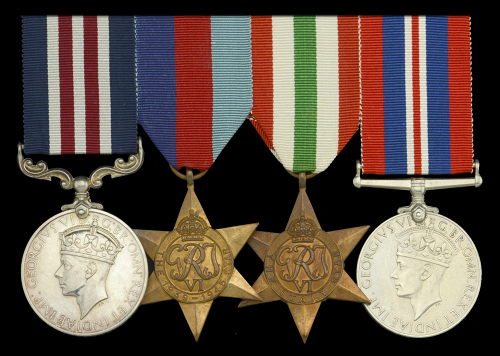
A Second World War 1944 immediate ‘Monte Cassino’ M.M. group of four awarded to Naik Kishanbahadur Gurung, 1/2nd King Edward VII’s Own Gurkha Rifles (The Sirmoor Rifles), who died on active service in Italy, 4 September 1944
Military Medal, G.VI.R. (1693 Naik Krishanbahadur [sic] Gurung 2 G.R.) officially engraved naming; 1939-45 Star; Italy Star; War Medal 1939-45, generally good very fine (4) £700-£900
M.M. London Gazette 20 July 1944. The original recommendation states:
‘On the night of 18 February 1944 in the Cassino Section, the 1st Battalion, 2nd Gurkha Rifles was ordered to attack in the hills in the vicinity of Monte Cassino Abbey. Naik Krishanbahadur Gurung was forming up his section under difficult conditions in.... when several enemy automatics opened up over very short range, and grenades were thrown. Every man in the section was either killed or badly wounded, Naik Krishanbahadur himself receiving a severe wound in the face. Despite this he fired his Tommy gun and threw grenades at the nearest post, silencing the enemy fire from that point. He then joined his platoon commander - also wounded - and with a handful of survivors, they advanced under heavy fire, taking part in attacks on other posts. When the order to consolidate came, Naik Krishanbahadur, although in great pain, assisted his platoon commander in organising stretcher parties. He refused to be evacuated himself until ordered to by his platoon commander, about 5 hours after being wounded. His determination to advance and destroy the enemy was an inspiration to all and his cool courage under heavy fire unsurpassed.’
Kishanbahadur Gurung was the son of Mayyan of Jutuwan, Asilkot, No. 2 West, Nepal. He served during the Second World War with the 1/2nd King Edward VII’s Own Gurkha Rifles (The Sirmoor Rifles) as part of the 7th Indian Infantry Brigade, 4th Indian Division in Italy. They were heavily engaged in the Second Battle of Monte Cassino, and took part in the direct assault on the monastery 17-18 February 1944, sweeping across the slopes and ravines in front of the building. The terrain was appalling, and despite the Gurkha’s ability in such surroundings they were forced to retreat suffering 96 officers and men killed, wounded or missing.
Krishanbahadur Gurung advanced to Havildar, and died on active service in Italy, 4 September 1944. He is commemorated on the Rimini Cremation Memorial, Italy.
Share This Page