Lot Archive


 Create new list
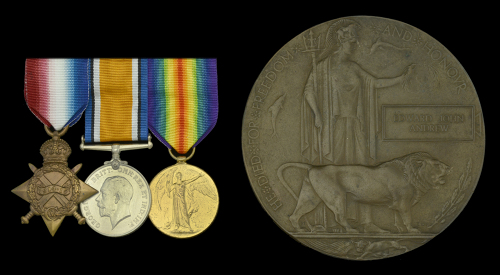
Three: Able Seaman E. J. Andrew, Royal Navy, who was killed in action in H.M.S. Goliath off Cape Helles in May 1915
1914-15 Star (189324. E. J. Andrew, A.B. R.N.); British War and Victory Medals (189324 E. J. Addrew. A.B. R.N.); Memorial Plaque (Edward John Andrew) extremely fine (4) £140-£180
Edward John Andrew was born in Falmouth, Cornwall on 6 July 1879, and entered the Royal Navy as a Boy 2nd Class in July 1896. Invalided ashore in January 1900, he enrolled in the Royal Fleet Reserve in May 1903 and was recalled in May 1914, when he joined the battleship H.M.S. Goliath.
He and his shipmates were subsequently deployed off East Africa, initially to blockade the Konigsberg in the Rufiji Delta but afterwards in November 1914, to the bombardment of enemy-held Dar es Salaam. In the first of those operations, Goliath’s Executive Officer Commander Henry Ritchie, was awarded the V.C. for his gallant command of the ship’s picket boat.
Goliath was next ordered to the Dardanelles, where she acted in support of the Gallipoli landings at Y Beach, Cape Helles on 25 April 1915. And she remained in support of wider operations over the coming two or three weeks, twice being damaged by Turkish shellfire.
On the night of 12-13 May, while on station with her consort Cornwallis off Cape Helles, she was intercepted by the Turkish destroyer Muâvenet-i Millîye and struck by three torpedoes. Two of them hit almost simultaneously, the first abreast her fore turret and the second abeam the fore funnel, causing a large explosion. Goliath began to capsize almost immediately and was lying on her side when a third torpedo struck near her after turret. Muâvenet-i Millîye escaped unscathed in the darkness as other British warships gathered to rescue survivors from Goliath. Out of her crew of 750, some 570 were killed in the sinking, Andrew being among them.
He has no known grave and is commemorated by name on the Plymouth Naval Memorial.
Share This Page